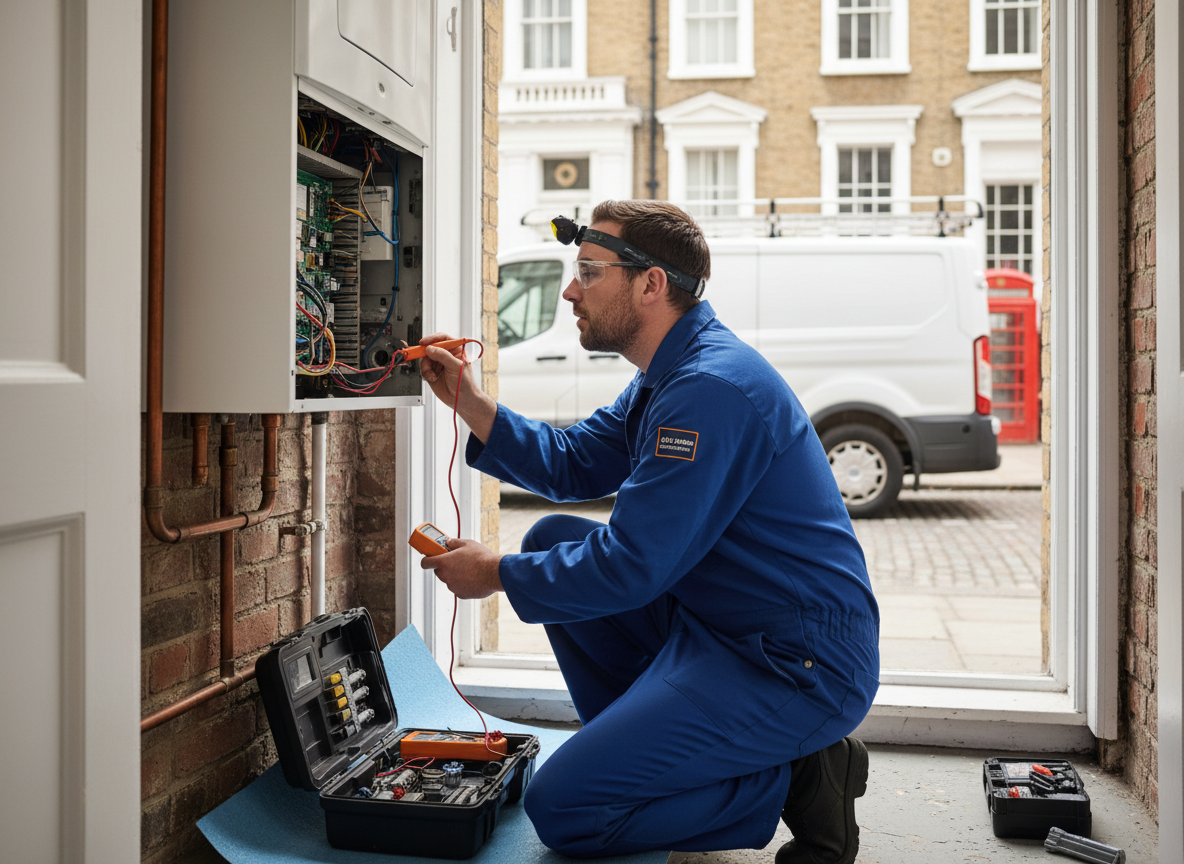
Electric boilers in London properties often fail due to age-related component wear, especially in Victorian and Edwardian conversions common across Islington, Hackney and Tower Hamlets. Older wiring and restricted plant room space frequently complicate access, requiring careful isolation of the 240V supply before any work begins. Corrosion on immersion heaters and thermostat failures are frequent in areas with hard water from the Thames supply.
Repair calls in the Canary Wharf and Docklands zones regularly involve units fitted during the 1990s and early 2000s commercial-to-residential conversions. These installations commonly suffer from inadequate ventilation and poor condensate drainage, leading to repeated element burnout. Engineers must check both the boiler control board and the incoming supply cable rating, as many older buildings still have 6mm tails that cannot safely support modern higher-output models.
Regulatory compliance under Part P and the latest IET wiring regulations is mandatory on every job. Any repair that involves altering the fixed wiring or replacing the consumer unit connection must be notified where required, and the system must be tested for earth continuity and insulation resistance before recommissioning. Homeowners in multi-occupancy blocks around the Royal Docks often face additional restrictions from building management on when noisy work can be carried out.
Seasonal demand spikes after the first cold snap in late October, when overnight temperatures drop sharply. At this point, many boilers that have been running at low load all summer suddenly show faults in the flow switch or safety cut-out. Carrying a stock of common elements, relays and sensors allows same-day repair on most standard single-phase units found in London flats.
Technician insight
In London, the thing that catches most people out with electric boiler repair is the state of the original wiring in 1980s and 1990s conversions around Canary Wharf and the Isle of Dogs. Many units were fitted with undersized cable that now overheats under modern load, so the first thing we check is the supply cable before touching the boiler itself.
Canary Wharf Penthouse Boiler Fault
A top-floor apartment in a 1990s conversion near Canada Square lost heating overnight. We found the flow switch had failed and the element had burnt out due to air lock from poor pipe gradients. After replacing the switch and element, flushing the system and correcting the air bleed point, the boiler ran reliably through the rest of the winter.
How it works
- 1
Initial Assessment
Engineer arrives, isolates power and records fault codes plus visual condition of the boiler and pipework.
- 2
Diagnosis
Full electrical and hydraulic checks identify whether the issue is the element, thermostat, PCB or circulation pump.
- 3
Repair or Replacement
Faulty parts are replaced using manufacturer-approved components and the system is refilled and vented.
- 4
Testing and Handover
Operation is verified across all settings, safety devices are confirmed and the customer receives a written report.
Pricing
Repair cost depends on parts needed and access difficulty; most jobs are completed within a single visit.