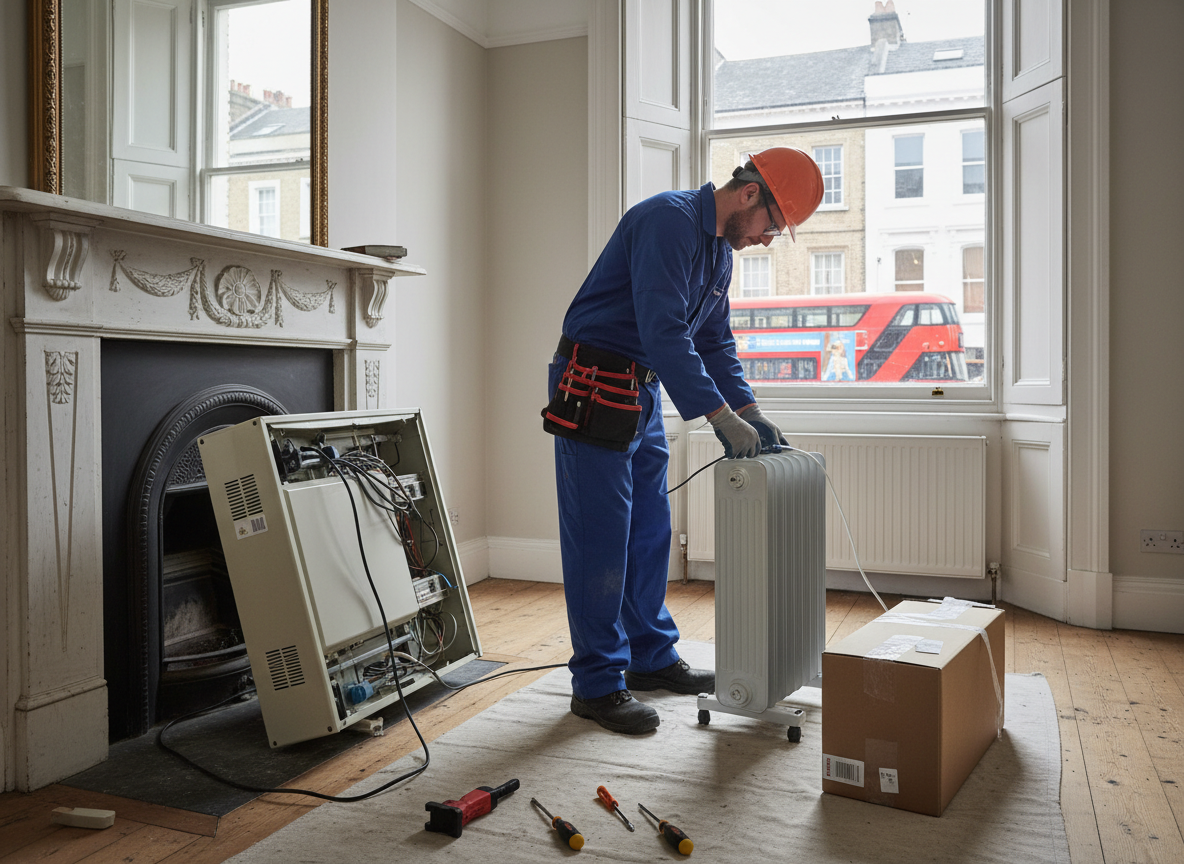
Electric heating replacement in London often involves properties built before 1950 where original wiring runs through plaster and timber joists. Homes in neighborhoods such as Tower Hamlets, Hackney and parts of Southwark frequently require full circuit upgrades before new panels and emitters can be fitted. Cold snaps in January and February push systems hard, revealing faults in aged storage heaters or night-rate setups that no longer meet current load demands. Technicians must check consumer units for RCD protection and ensure new heaters integrate with existing Economy 7 tariffs without overloading shared risers in blocks.
Removal work starts with isolating the circuit at the main board and safely extracting old night storage units that can weigh over 100 kg each. Dust and debris from these units often contain asbestos residues in pre-1980 Canary Wharf and Isle of Dogs flats, requiring careful bagging before disposal at licensed sites. New electric radiators or underfloor mats are then positioned to avoid existing pipework and to respect the limited floor depths common in converted warehouses. Final commissioning includes verifying earth continuity and testing each zone under full load to prevent nuisance trips during peak evening use.
Edge cases appear regularly in multi-storey terraces where upper floors have different supply phases from the ground floor. Replacement jobs here demand coordination with the district network operator to confirm supply capacity before larger 3 kW panels are installed. London’s variable ground conditions also affect underfloor heating retrofits in basements near the Thames, where moisture levels can degrade insulation if vapour barriers are not fitted correctly.
Homeowners sometimes attempt partial swaps, leaving old contactors in place. This creates repeated call-outs when the new heaters draw current through worn components. A full replacement avoids these repeat visits and brings the installation in line with current IET wiring regulations.
Technician insight
In London, the thing that catches most people out with electric heating replacement is the state of the original wiring in Victorian terraces around Tower Hamlets and Hackney. The cables are often undersized for modern panel heaters and share risers in converted houses, so a straight swap trips the board within days. We always pull new dedicated runs from the consumer unit rather than reusing old tails.
Storage Heater Swap in Canary Wharf Flat
A top-floor flat near 1 Canada Square had three ageing night-storage heaters that failed during a cold snap. Inspection showed the original wiring lacked RCD protection and shared a circuit with the kitchen. We isolated the supply, removed the units, installed new slimline electric radiators on dedicated 20 A circuits and retested the board under load. The system now runs efficiently on the existing Economy 7 tariff without tripping.
How it works
- 1
Initial Survey
Visit the property to map existing circuits, measure load and note any shared risers or Economy 7 metering.
- 2
Isolation and Removal
Isolate power, safely extract old storage heaters or panels and prepare surfaces for new fixings.
- 3
New Installation
Mount replacement electric radiators or mats, run new dedicated circuits where needed and connect to the consumer unit.
- 4
Testing and Handover
Perform full load and earth tests, set timers or smart controls and provide usage guidance.
Pricing
Cost depends on number of rooms, existing wiring condition and whether circuit upgrades are needed. Upfront quotes provided after survey.