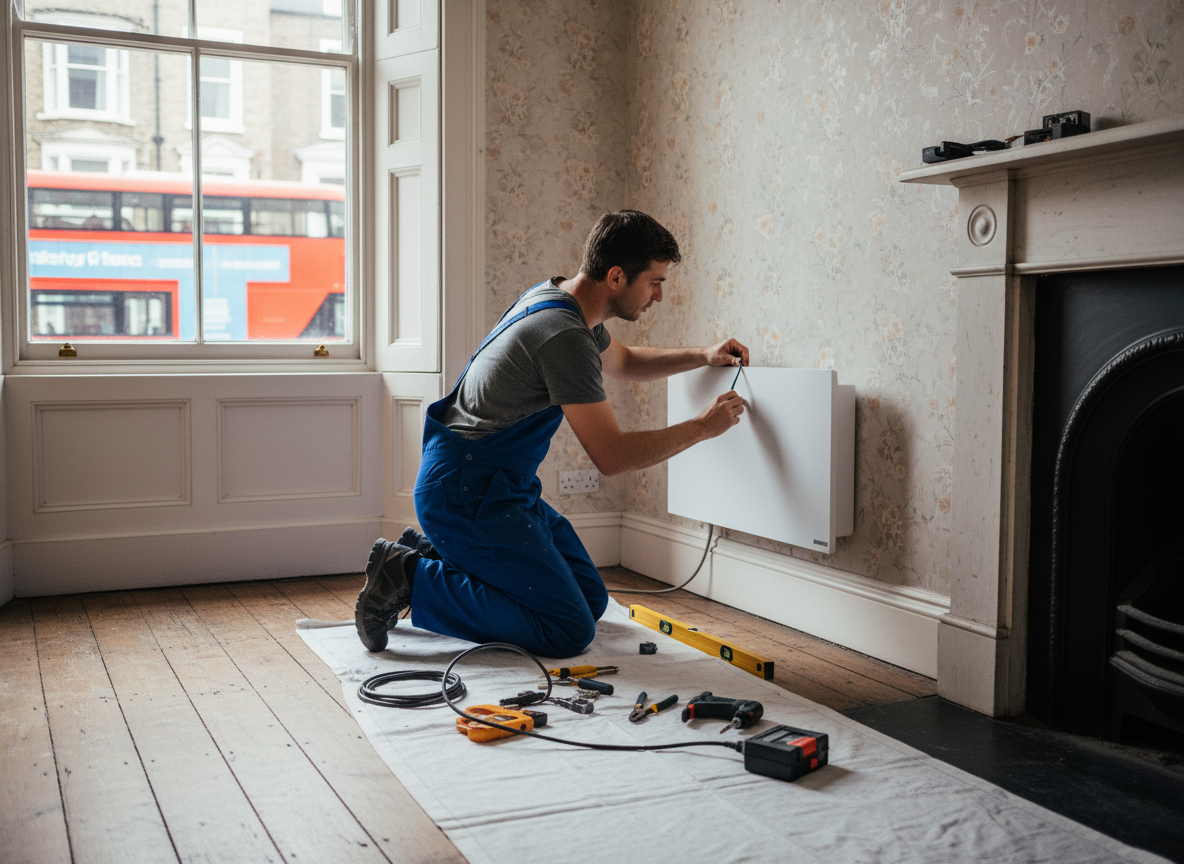
London’s mix of Victorian terraces, 1930s semis and post-war flats means every electric panel heater job starts with checking the existing consumer unit and circuit capacity. Many properties in areas such as Hackney, Islington and Tower Hamlets still rely on 1960s or 1970s wiring that cannot safely carry additional loads without an upgrade. We survey the board, meter tails and earthing before any heaters are ordered so the installation meets current Part P and IET wiring regulations.
Winter temperatures in the capital regularly drop below freezing and older solid-wall properties lose heat quickly through single glazing and uninsulated lofts. Panel heaters with built-in electronic thermostats and seven-day timers give room-by-room control that helps keep bills manageable in these draughty homes. We also fit models with open-window detection for flats in high-rise blocks around Canary Wharf where residents frequently leave windows ajar.
Listed buildings and conservation areas around central London often restrict surface trunking and require concealed cabling. Our installers use existing chases or low-impact mini-trunking routes that satisfy both building control and conservation officers. All work is left ready for the client or their electrician to arrange the final notification to the local authority.
We carry a range of slimline panels, high-output models for larger reception rooms and low-wattage versions suitable for well-insulated modern apartments. Every installation finishes with a full test of each circuit, labelling of the new breakers and handover of the manufacturer’s instructions and warranty cards.
Technician insight
In London the thing that catches most people out with electric panel heater installer is the state of the consumer units in pre-1980 terraces around Hackney and Islington. Many still have rewireable fuses or early MCB boards that simply will not accept another 20 A circuit without a full board upgrade first.
Canary Wharf Penthouse Panel Installation
A top-floor apartment in E14 had no spare ways in the consumer unit and suffered rapid heat loss through floor-to-ceiling glazing. We identified that two new 16 A radials could be run from the existing board after a small upgrade. Four slimline panels with electronic controls were fitted and programmed. The client now maintains steady 20 °C room temperatures without tripping breakers.
How it works
- 1
Site Survey And Load Check
We inspect the consumer unit, earthing and available circuits in your London property to confirm the installation is feasible without major electrical upgrades.
- 2
Heater Selection And Positioning
We recommend panel sizes and locations that match room dimensions, window placement and typical heat-loss patterns found in local housing stock.
- 3
Installation And Wiring
New dedicated circuits are run where needed, heaters are mounted and connected, and all work is tested before the system is energised.
- 4
Commissioning And Handover
Each heater is programmed with timers and thermostats, the client receives full operating instructions and we leave the workspace clean.
Pricing
Upfront quotes issued after the site survey; final price depends on circuit upgrades needed and number of heaters.