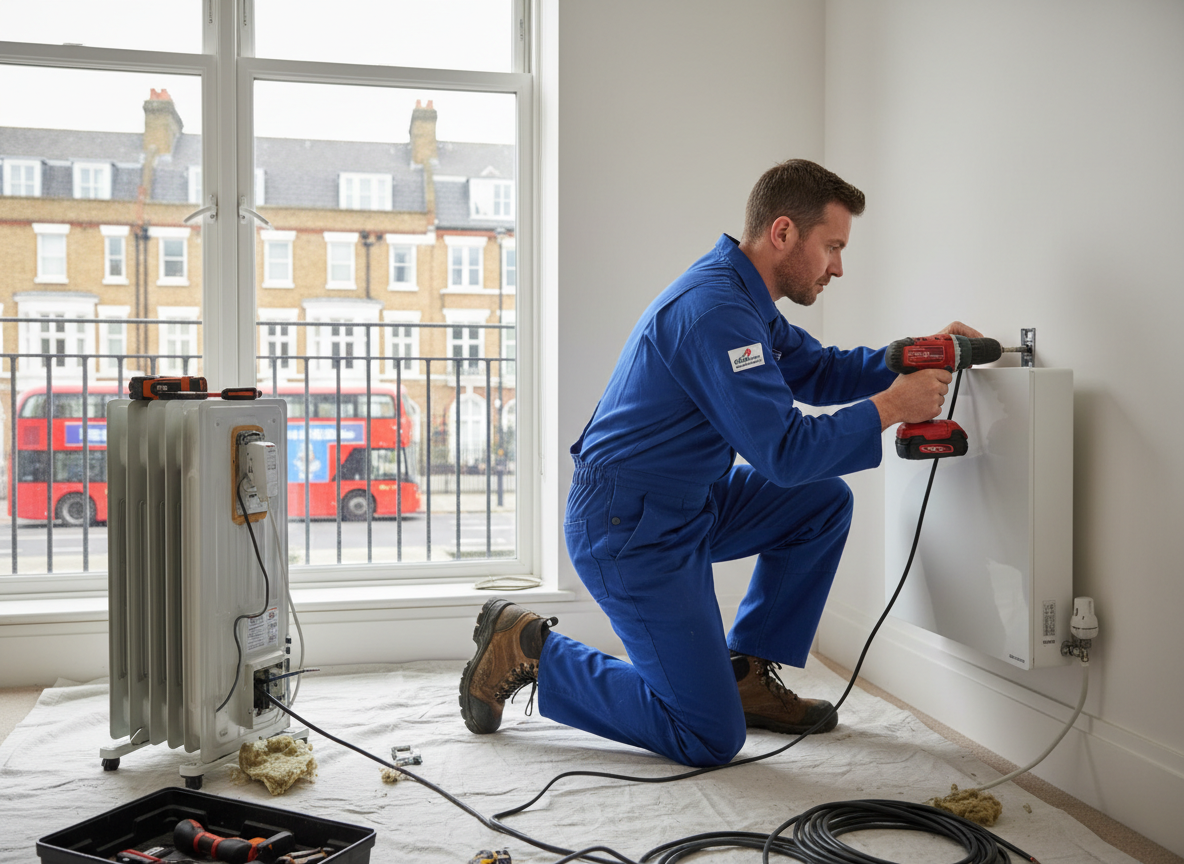
London's housing stock ranges from Victorian terraces in areas like Hackney to 1960s concrete blocks near Canary Wharf. Storage heaters work well here because they use cheaper off-peak electricity overnight when demand on the grid is lower. Installation often requires checking the existing consumer unit capacity first, as many pre-1970 properties have 60-amp or 80-amp boards that cannot handle modern loads without an upgrade.
Moisture levels in ground-floor flats along the Thames can affect heater placement and wiring routes. We run dedicated circuits from the consumer unit to each unit to avoid shared lines that overheat during winter peaks. In taller buildings around E14, we also account for lift shaft interference when routing cables between floors.
Older properties frequently have asbestos in ceiling voids or underfloor spaces. Before any drilling or chasing we carry out a visual survey and stop work if suspect material appears. This keeps the job compliant with current HSE guidance without unnecessary delays.
Night storage heaters need proper ventilation gaps behind the unit and above to prevent overheating. In compact London kitchens or hallways this often means choosing slimline models or repositioning radiators entirely.
Technician insight
In London, the thing that catches most people out with Storage Heater installer is the state of the incoming supply cable in pre-1960s blocks around Canary Wharf and the Isle of Dogs. Many still have 16mm tails that limit how many modern storage heaters you can add without a DNO upgrade.
Storage heater replacement in a 1970s E14 flat
The existing heaters had tripped the board repeatedly during cold snaps. We found shared 2.5mm cable feeding three units. New dedicated 4mm radials were run from an upgraded consumer unit in the hallway, and the old units were swapped for slimline models that fit the narrow corridor. The system now charges cleanly on the Economy 7 tariff without further trips.
How it works
- 1
Site Survey
We inspect the consumer unit, existing circuits and wall construction at your London address to confirm suitability for new storage heaters.
- 2
Circuit Planning
Dedicated radial circuits are designed from the consumer unit to each heater location, accounting for load and cable routes through older walls.
- 3
Installation
Heaters are mounted with correct clearances, wired on the new circuits and connected to the off-peak supply via the appropriate time switch or smart controller.
- 4
Testing And Handover
Full electrical testing is carried out, followed by a demonstration of charge and discharge settings for the homeowner.
Pricing
Upfront quotes after site survey; price depends on number of units, any consumer unit upgrades and access constraints in the property.